Metrics
A metric is a curated business definition: revenue, conversion rate, revenue MTD. Metrics are built on measures and are always defined by an administrator — Axiome never generates them automatically, because a business definition is a decision, not a guess.
Metrics appear in their own Metrics group in field pickers, and Axi prefers them when answering business questions — one more reason to define the ones your team actually uses.
Metric types
Simple
Wraps a single measure. Useful to promote a measure to a first-class, named, formatted business term.
Ratio
A numerator measure divided by a denominator measure — e.g. conversion rate = purchases / visits. Both sides are computed correctly at whatever grouping the widget uses (no "average of ratios" mistakes).
Derived
A formula combining other metrics — e.g. (revenue - cost) / revenue.
Formulas support period offsets:
offset(metric, 1, month)— the metric's value one month earlier, for period-over-period comparisons likerevenue / offset(revenue, 1, year) - 1.offset_to_grain(metric, month)— the metric's value at the start of the period.
Comparisons to a prior period require the widget to include a time grouping.
Cumulative
Accumulates a measure over time:
- Running total — since the beginning.
- To date — resets at each period start: MTD, QTD, YTD (configurable grain).
- Trailing window — a rolling window of N periods (configurable size and grain).
Cumulative metrics require a date grouping in the widget.
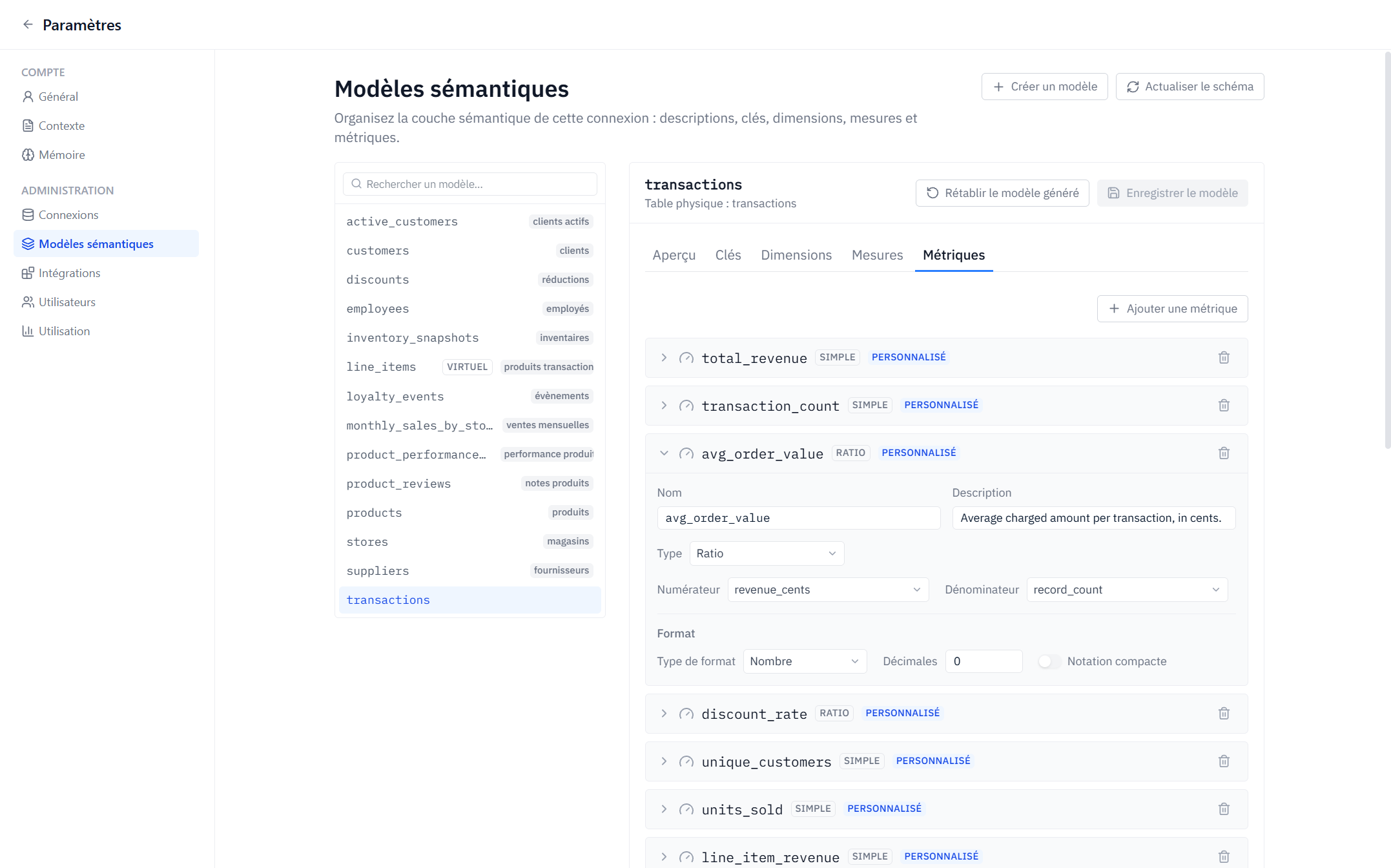
Formatting
Each metric carries its display format, applied everywhere it is shown: Default, number, percent, or currency (with its currency code), a number of decimals, and optional compact notation (1.2M instead of 1 200 000).
Good metric hygiene
- Name metrics the way your business talks — Axi and your teammates will find them by name.
- Add a description stating the exact definition; it removes ambiguity for humans and grounds Axi.
- Prefer defining a metric once over repeating the same measure + filters in many widgets.