Company context and memory
Everyone can read the company context; only administrators can edit it, or delete company memories.
The semantic layer tells Axi what your data means. The company context tells it what your business means — the things no schema can express.
Both are read before every analysis, for every user in the workspace.
The company context document
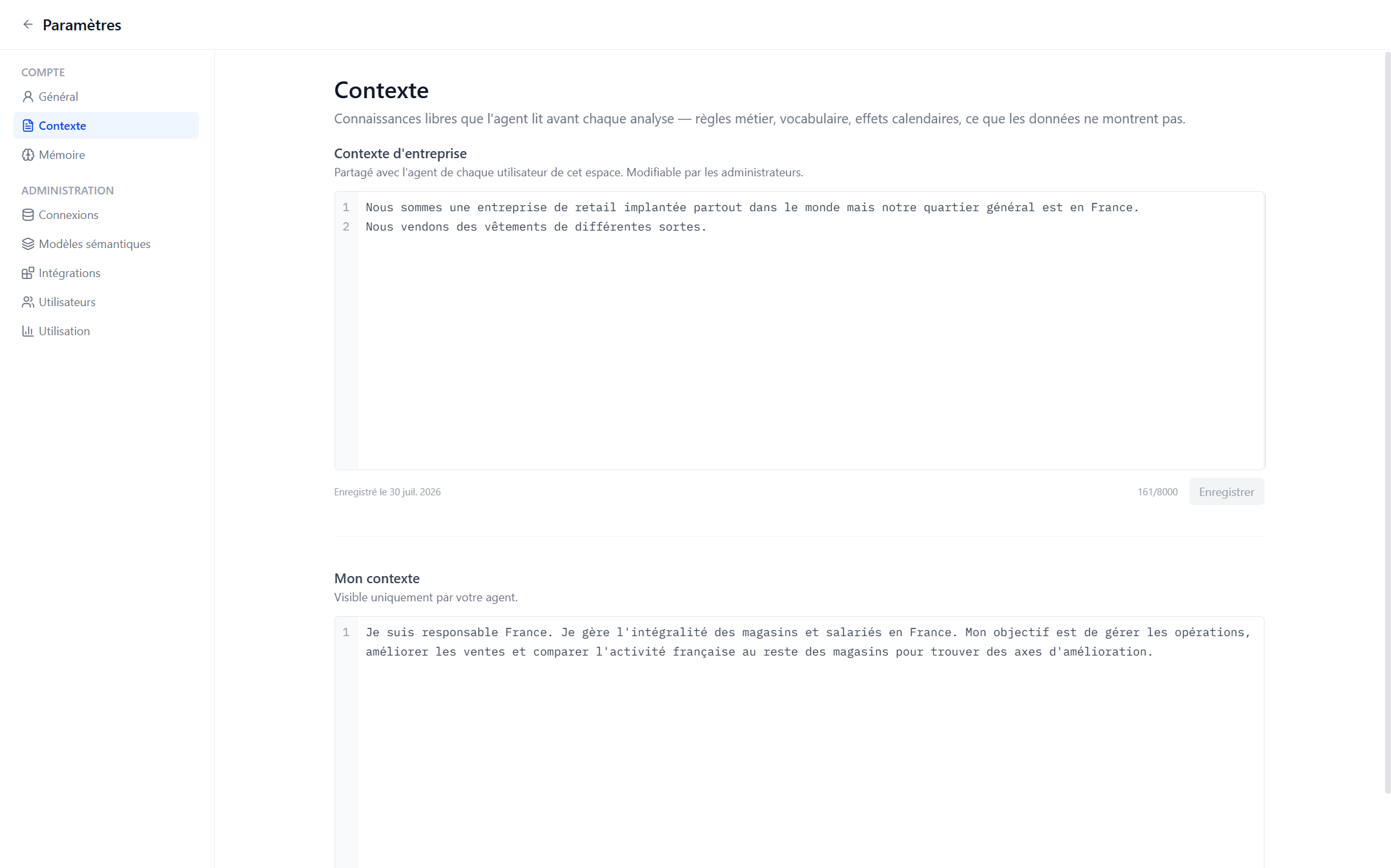
Settings → Account → Context → Company context
Shared with every user's agent in this workspace. Edited by admins.
Free-form prose, up to 8 000 characters, editable only by administrators (members see it read-only — they need to know what's shaping their answers). It's the highest-leverage text in your workspace after the semantic layer itself.
What belongs in it
The placeholder sets the tone exactly right:
Our fiscal year starts in February. April 2025 bank holidays fell on Saturdays, so April 2025 visits are structurally low. "Active customer" means at least one order in the last 90 days.
Three families are worth writing down:
- Business rules and definitions — what a term means when your teams say it, especially when it differs from the obvious reading of the data.
- Calendar and structural effects — fiscal year, seasonality, one-off events that make a period look anomalous when it isn't. This alone kills a surprising number of false "anomalies".
- What the data can't show — a warehouse migration mid-year, a shop that closed, a tracking change. Context Axi has no other way to know.
What doesn't belong
- Field definitions — those go in the semantic layer, where they also govern every chart and table, not just Axi.
- Metric formulas — define a metric; a definition written in prose isn't computed, it's only read.
- Anything secret — every member's Axi reads this document.
- Instructions about tone or behaviour — it's reference knowledge, not a control panel.
The rule of thumb: if it changes what a number is, it belongs in the semantic layer. If it changes how a number should be read, it belongs in the context.
Keeping it honest
Nothing expires on its own. A context line that was true last year and isn't anymore will keep steering answers. Re-read the document when your fiscal calendar, your definitions, or your data sources change — and delete rather than accumulate. Saving an empty document removes it entirely.
Memories
Alongside the two context documents, Axi saves short durable facts as it works — "remember that our fiscal year starts in February". These come in two kinds, and the difference matters to you:
| Personal memories | Company memories | |
|---|---|---|
| Whose Axi reads them | Only their owner's | Every member's |
| Shown to | Their owner | Everyone, tagged "Company memory — shared with the whole workspace" |
| Who can delete | Their owner | Administrators only (memories.manage_company) |
| Cap | 100 per user | 200 per workspace |
Members see company memories in their own Settings → Account → Memory list but can't remove them — they get "Company memories are managed by workspace admins." That makes them your responsibility: a wrong company memory quietly skews every user's answers, exactly like a wrong line in the company context.
Give the company memories the same periodic review as the context document. Each carries the date it was saved, so stale ones are easy to spot.
Personal context and memory stay with each user — a personal document and their own saved facts, which they curate themselves. Those are documented for them in Context and memory; there's deliberately no admin console for personal knowledge.
Every memory is capped at 500 characters, and the whole set injected into a conversation is capped at 6 000 — so a bloated memory list crowds itself out rather than growing without limit.
Why this improves answers
A user asking "why did April drop?" against a schema alone gets a description of a drop. With a context line explaining the bank holidays, they get the actual explanation — and Axi will say the company context is what led it there.
If your team reports that Axi "doesn't understand our business", the fix is usually a few lines here, not a different model:
- Terms your team uses that Axi doesn't recognize → semantic layer names and descriptions.
- Periods that look broken but aren't → company context.
- Business rules Axi keeps getting wrong → company context, or a curated metric if it's a calculation.